

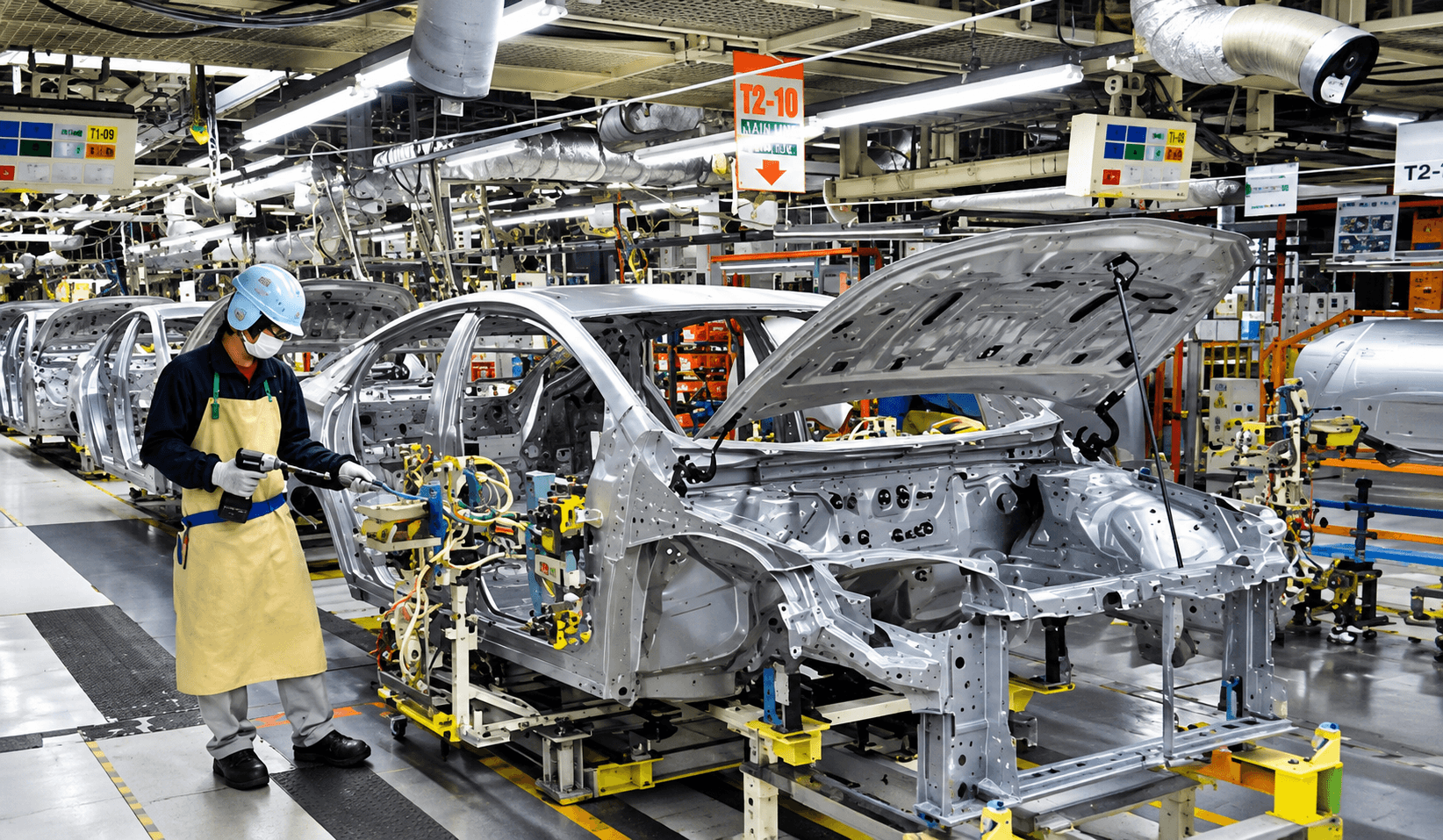
Japan’s manufacturing sector is gaining momentum as the global AI boom fuels demand for semiconductors, electronic components and advanced industrial equipment. The latest survey from the Bank of Japan (BOJ) shows that confidence among the country’s large manufacturers has reached its highest level in eight years.
The BOJ’s quarterly Tankan survey, released on 1 October, put the sentiment index for large manufacturers at +24 for July–September 2026, up from +22 in the previous quarter. That was the strongest reading since March 2018, although it fell just short of the market forecast of +25.
The improvement reflects growing demand for products that support the expansion of AI infrastructure. Japanese companies supplying chipmaking equipment, semiconductor materials and other technology components are benefiting as businesses worldwide invest in computing capacity. Some manufacturers have also managed to protect their profit margins by passing higher material costs on to customers.
Still, the recovery is far from universal. Confidence among large non-manufacturing companies weakened, and businesses across the economy remain concerned about what lies ahead.
For Japan, the latest figures highlight a growing divide. Companies tied to the AI and semiconductor supply chain are finding new opportunities, while businesses more exposed to domestic consumption, higher energy prices and rising labour costs continue to face pressure.
WHAT THE TANKAN SURVEY REVEALS
The Tankan is one of the Bank of Japan’s most closely watched economic surveys. It asks businesses how they view current conditions and what they expect in the months ahead, giving policymakers an important indication of corporate confidence, investment plans and economic momentum.
Its diffusion index measures the difference between the percentage of companies reporting favourable business conditions and those reporting unfavourable conditions. A positive reading means optimistic responses outnumber pessimistic ones.
The latest results show that confidence among large manufacturers has improved for six consecutive quarters.
Large manufacturers’ business sentiment
June 2026: +22
September 2026: +24
Market forecast: +25
Source: Bank of Japan Tankan survey, released 1 October 2026.
The figures suggest that manufacturers are benefiting from a sustained improvement rather than a brief rebound. Demand for AI-related products has helped support orders, while easing supply constraints has made it easier for some companies to meet customer requirements.
The gains also show how investment decisions made overseas can influence Japan’s industrial economy. As other major economies spend more on AI infrastructure, Japanese suppliers of specialised machinery, electronic components and advanced materials stand to benefit.
However, the latest reading came in slightly below expectations. The direction is encouraging, but manufacturers are not immune to a slowdown in global demand or a fresh rise in operating costs.
AI IS BECOMING A MAJOR DRIVER OF INDUSTRIAL DEMAND
The expansion of AI is creating opportunities across a supply chain that extends well beyond software developers and companies building large language models.
AI systems depend on processors, memory chips, storage, networking equipment, power-management components and increasingly sophisticated data centres. Manufacturing these products requires specialised machinery and materials, giving Japanese industrial companies an opportunity to benefit from the global investment boom.
Semiconductor equipment and precision machinery
Chipmakers around the world are investing in additional production capacity to meet demand for advanced computing. That spending creates business for manufacturers of semiconductor production equipment, precision instruments and specialised industrial components.
Japan has established strengths in several parts of this supply chain, particularly semiconductor materials and manufacturing equipment. When chipmakers build new facilities or upgrade existing plants, Japanese suppliers can win orders for the tools and materials needed to produce advanced chips.
The latest Tankan results reflect the wider strength of technology-related demand. A separate Reuters business survey published in October also pointed to semiconductor demand as a source of support for Japanese manufacturers, with precision machinery among the stronger-performing sectors.
Electronics and advanced components
AI infrastructure requires much more than processors. Circuit boards, electronic components, power systems, cooling equipment and other specialised hardware are also essential.
Japanese manufacturers supplying these markets could see further gains as technology companies and data-centre operators increase their investment.
The opportunity extends across several industries rather than depending on a single AI company or product. Equipment makers, component suppliers and industrial businesses involved in building and operating computing facilities can all benefit from continued spending.
But the outlook is not without risks. Semiconductor markets are cyclical, and orders can fluctuate sharply. Companies that expand production too quickly could face excess inventory or weaker prices if investment slows.
The limits of the AI boom
AI demand is helping lift business confidence, but it cannot guarantee growth across the entire manufacturing sector.
The biggest benefits are likely to go to companies supplying the strongest areas of technology spending. Businesses facing weak demand, expensive energy or limited ability to raise prices may see much smaller gains.
The real test is whether the current surge in orders leads to sustained investment, stronger profits and more stable employment, rather than a temporary burst of activity.
JAPAN’S MANUFACTURING ADVANTAGE
Japan’s position in the AI supply chain has been built over decades. Its industrial base includes companies producing specialised machinery, high-performance materials, electronic components and precision equipment used by manufacturers worldwide.
These capabilities are not easy to replicate overnight. They rely on technical expertise, established supplier networks and the ability to maintain consistent production quality.
The global push to expand semiconductor manufacturing gives Japanese companies an opportunity to build on those strengths. As countries seek more resilient supply chains and chipmakers invest in new facilities, demand for specialised equipment and materials could provide further support.
The opportunity also fits with Tokyo’s broader efforts to strengthen domestic semiconductor production and develop its AI capabilities. Government-backed investment and support for advanced manufacturing are intended to reinforce Japan’s industrial base and improve economic security.
However, public support alone cannot guarantee commercial success. Companies still need competitive products, efficient production and dependable customers to turn investment into lasting growth.
Japan’s longer-term challenge is to translate its manufacturing expertise into a larger share of the value created by the global AI economy.
THE SERVICES SECTOR TELLS A DIFFERENT STORY
While large manufacturers became more optimistic, confidence among large non-manufacturing companies moved in the opposite direction.
The Tankan index for large non-manufacturers fell to +35 in September from +37 in June, marking its first decline in five quarters. The result also came in below the market forecast of +36.
That contrast matters because services account for a substantial share of Japan’s economic activity. Retailers, restaurants, hotels, transport operators and other consumer-facing businesses depend heavily on household spending.
Many of these companies are struggling with higher material, energy and labour costs. Raising prices can help protect profits, but businesses risk losing customers if increases stretch household budgets too far.
The BOJ’s survey reporting also pointed to disruption from adverse weather, including typhoons and prolonged rain, affecting parts of the services sector.
The result is an uneven economic picture. Manufacturers linked to global technology spending are benefiting from stronger demand, while some domestic businesses continue to struggle with rising costs and cautious consumers.
Why consumer spending matters
A lasting manufacturing recovery needs more than strong exports and investment. Healthy domestic demand is also important.
If households cut back on durable goods and other non-essential purchases, businesses that rely on the Japanese market may continue to struggle even while technology-related exporters perform well.
Weak spending also makes it harder for companies to pass higher costs on to customers. Businesses may have to absorb more of those increases, squeezing profits and leaving them less willing to invest or hire.
For policymakers, the challenge is to support economic growth while keeping inflation under control and protecting the recovery in household demand.
RISING COSTS AND GLOBAL UNCERTAINTY REMAIN RISKS
The stronger Tankan reading is encouraging, but it does not remove the risks facing Japanese manufacturers.
Energy and raw-material costs remain important concerns. Some companies have been able to offset higher expenses by raising prices, but that strategy has limits, particularly when customers are reluctant or unable to pay more.
Geopolitical tensions add another layer of uncertainty. Developments in the Middle East can affect energy prices and market expectations, creating additional pressure for Japan, which relies heavily on imported energy.
Supply chains could also come under strain again if geopolitical tensions escalate or trade restrictions disrupt the movement of industrial goods and advanced technology.
There is uncertainty within the AI boom itself. Strong investment is creating opportunities for Japanese suppliers, but technology companies could change their spending plans if returns from AI infrastructure fall short of expectations or financing becomes more expensive.
For manufacturers, maintaining an advantage will require continued investment in productivity, technology and operational efficiency. Relying on current demand alone will not be enough.
WHAT THE RESULTS MEAN FOR THE BANK OF JAPAN
The Tankan survey is an important indicator for the BOJ as it weighs economic growth against inflation.
Japan has been gradually moving away from the ultra-low interest-rate environment that shaped its economy for years. Higher rates can help contain inflation, but they also increase borrowing costs for businesses and households.
The latest survey sends a mixed message to policymakers.
Stronger confidence among manufacturers suggests that parts of the corporate sector remain resilient despite global uncertainty. However, the decline in non-manufacturing sentiment and continued pressure on household spending point to an uneven recovery.
Reuters reported that the latest survey eased immediate pressure for another consecutive rate increase following the BOJ’s September move, while leaving open the possibility of further tightening if economic and inflation conditions justify it.
The Tankan alone will not determine the central bank’s next decision. Policymakers will also need to consider wage growth, inflation, consumer spending, industrial output and developments in global markets.
Investment plans will be crucial
Capital expenditure is another important part of the picture. Large Japanese companies have indicated plans to increase investment during the current fiscal year, although those intentions could change if costs rise or demand weakens.
For the BOJ, the key question is whether stronger business confidence translates into sustained spending, productivity improvements and wage growth, or whether the gains remain concentrated in a relatively small group of industries.
A broader investment cycle could provide lasting support for the economy. But if inflation stays elevated while household demand weakens, the central bank will face a more difficult policy balancing act.
CAN JAPAN KEEP THE MOMENTUM GOING?
The eight-year high is an important milestone, but the next few quarters will show whether manufacturers can maintain their current momentum.
Several factors will shape the outlook.
First, global investment in AI infrastructure needs to remain strong enough to support demand for semiconductors, production equipment and electronic components. If major technology companies stick to their spending plans, Japanese suppliers could continue to benefit.
Second, manufacturers must protect their margins. Higher sales do not necessarily translate into stronger profits if energy, materials and labour become more expensive.
Third, domestic demand needs to hold up. A recovery concentrated among large exporters would leave many businesses dependent on Japanese consumers vulnerable to weaker spending.
Finally, companies will need to keep investing in innovation and productivity. Japan has significant industrial strengths, but competition from other manufacturing economies remains intense.
The latest Tankan reading gives manufacturers a stronger foundation. It does not mean that every company or industry will share equally in the gains.
FACT CHECK METER
FACT METER: 98% — CORE TANKAN FIGURES REPORTED; THE LONGER-TERM OUTLOOK REMAINS UNCERTAIN
STATUS: The Bank of Japan’s quarterly Tankan survey, released on 1 October 2026, showed that sentiment among large manufacturers rose to +24 for July–September, its highest level since March 2018. Strong demand for AI-related products and semiconductors helped support confidence, while sentiment among large non-manufacturers weakened.
CONFIRMED DETAILS
The large manufacturers’ sentiment index rose from +22 in June to +24 in September 2026.
The reading was the highest since March 2018.
The result fell just short of the market forecast of +25.
Sentiment among large non-manufacturers declined from +37 to +35.
Demand for AI-related products and semiconductors was among the factors supporting manufacturers’ confidence.
IMPORTANT DISTINCTIONS
The Tankan index measures the balance of favourable and unfavourable business assessments. It does not directly measure manufacturing output, revenue or profitability.
AI demand is an important source of support, but it is not the only factor influencing business sentiment.
An eight-year high in confidence does not mean every Japanese manufacturer is performing well.
The outlook remains vulnerable to energy prices, geopolitical tensions, domestic consumption and changes in global technology investment.
AWX VERDICT: Japan’s manufacturers are benefiting from the global AI and semiconductor investment cycle. The latest figures point to a clear improvement in business confidence, but weaker sentiment in services and continued cost pressures mean a broad, lasting economic recovery is not yet assured.
WHAT TO WATCH NEXT
The next Tankan survey: Will manufacturers become even more optimistic, or will confidence begin to level off?
AI and semiconductor orders: New orders for chipmaking equipment, precision machinery and electronic components will help show whether demand remains strong.
Capital expenditure: Corporate investment plans will indicate whether improved sentiment is translating into additional production capacity.
Consumer spending: Stronger household demand would help spread economic growth beyond export-oriented manufacturers.
Energy prices: Higher oil and gas costs could put fresh pressure on industrial margins and household budgets.
BOJ interest-rate decisions: Policymakers will need to balance corporate resilience against inflation and weakness in parts of the domestic economy.
Global AI investment: Spending decisions by major technology and cloud companies will influence demand for Japanese suppliers.
Manufacturing profitability: Companies’ ability to pass higher costs on to customers will be crucial to sustaining confidence.
THE AWX BOTTOM LINE
Japan’s big manufacturers are more confident than at any point in eight years, with the global AI boom providing an important boost. Stronger demand for semiconductors, precision machinery and related equipment is creating opportunities across parts of the industrial economy.
But the recovery remains uneven. Confidence in the services sector has weakened, consumers are still feeling the pressure of higher prices, and manufacturers remain exposed to energy costs and geopolitical uncertainty.
Japan’s next challenge is to turn AI-driven demand into lasting industrial growth. Continued investment, stronger productivity and healthier domestic consumption could help the country strengthen its position in the global technology supply chain.
If costs keep climbing or global AI spending slows, however, the current optimism could prove difficult to sustain.
For now, the message from Tokyo is encouraging. Whether it marks the beginning of a broader recovery will depend on how well manufacturers and the wider economy handle the challenges ahead.
ATTLAS WIRE | AWX WORLD NEWS
Real Stories. Lasting Impact.



Comments
No comments yet.