

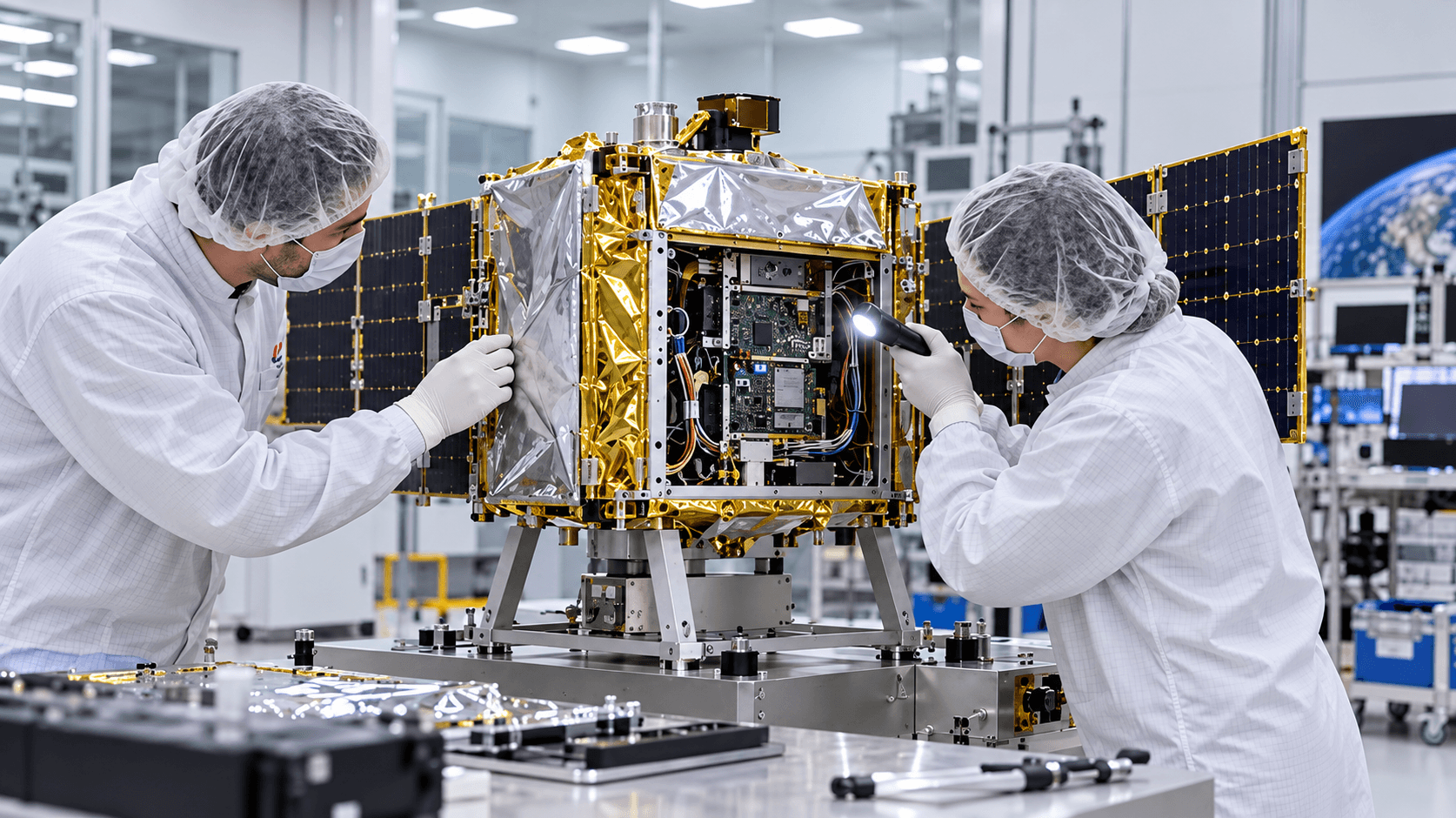
Google is taking its artificial intelligence ambitions beyond Earth, testing whether its custom-built AI processors can operate reliably in space.
The technology giant has launched a prototype satellite carrying its Tensor Processing Units (TPUs), marking an important step in its effort to explore space-based computing. The experiment is designed to find out how the hardware performs under the demanding conditions of orbit and whether solar-powered satellites could eventually support AI workloads.
The mission is part of Project Suncatcher, Google's long-term research initiative exploring the possibility of building computing infrastructure in space. Developed in partnership with satellite company Planet Labs, the prototype reportedly launched aboard SpaceX's Transporter-18 rideshare mission on 1 October 2026. Google confirmed that contact had been established with the satellite and that it was operating as expected. <Cite refs={["turn506118search0","turn506118news6"]}/>
The satellite is small, but the idea behind the project is ambitious. Google wants to understand whether satellites carrying AI processors could eventually work together as a network of computers, using solar energy to power workloads that would otherwise run in data centres on Earth.
The timing is significant. As AI models become more powerful, technology companies are investing heavily in data centres, which require substantial amounts of electricity, cooling equipment, land and network capacity. Finding new ways to meet that demand has become an increasingly important challenge.
Still, Google is not about to replace its terrestrial data centres with satellites. The current mission is an early research experiment focused on hardware reliability, radiation exposure, temperature control and the practical difficulties of running computing equipment in orbit.
What engineers learn could help determine whether space-based AI is worth pursuing on a larger scale or whether the technical and financial barriers remain too high.
PROJECT SUNCATCHER: FOUR AI CHIPS IN ORBIT
At the heart of the prototype are four Google TPUs, specialised processors designed to handle machine-learning tasks. Google already uses this technology in its data centres to train and run AI models.
The satellite, built using Planet's spacecraft platform, is roughly the size of a refrigerator and relies on a solar-power system capable of supplying around one kilowatt. Its purpose is to test some of the essential technologies that a much larger orbital computing network would need. <Cite refs={["turn506118search1","turn506118search2"]}/>
During the mission, engineers will study how the processors cope with launch vibrations, radiation and the extreme temperature changes associated with low Earth orbit.
Google has already carried out ground-based experiments, including vibration and radiation testing. Those tests are useful, but they cannot fully reproduce the conditions a satellite encounters while operating in space.
An orbital mission gives engineers the chance to see how the hardware behaves under real-world conditions rather than relying entirely on laboratory results.
Why start with just four processors?
A conventional AI data centre may contain thousands of accelerators working together. Google's satellite carries only four TPUs, and that is intentional.
Before attempting to connect hundreds or thousands of processors in orbit, the company needs to establish that the hardware can operate reliably and that the spacecraft's power and cooling systems can keep up with the demands of AI computing.
Starting small also gives engineers an opportunity to identify problems before committing to a much larger and more expensive system.
Google has presented Project Suncatcher as a long-term research effort, not a product that is ready for commercial use. Future missions could build on the current experiment by testing communication links and coordinated computing between multiple satellites. <Cite refs={["turn506118news4","turn506118search14"]}/>
WHY TAKE AI COMPUTING INTO SPACE?
The biggest attraction is solar energy. In the right orbital conditions, satellites can receive sunlight for extended periods and generate electricity without depending on terrestrial power grids.
That possibility matters because AI computing is becoming increasingly energy-intensive. Data centres need electricity not only to run processors but also to power networking equipment, storage systems and cooling infrastructure. Depending on their design, they may also place pressure on local water supplies and land availability.
A carefully designed network of solar-powered satellites could potentially generate electricity in orbit and use it to run AI workloads, avoiding some of the constraints faced by large facilities on Earth.
That is the broader vision behind Project Suncatcher: a network of satellites equipped with TPUs, powered by solar energy and linked together to perform machine-learning tasks. <Cite refs={["turn506118search14","turn506118news7"]}/>
The appeal is easy to understand. Building a new data centre on Earth can involve lengthy planning, construction work and negotiations over electricity supply. Space-based infrastructure could eventually provide another way to expand computing capacity.
But moving into orbit does not make the infrastructure problem disappear. Satellites still need solar panels, processors, radiators, communications equipment and protection against the space environment. All of that adds weight, complexity and launch costs.
Repairs are another concern. When equipment fails in a terrestrial data centre, technicians can often replace it. A faulty component in orbit may be much harder and more expensive to fix.
The real test, then, is not simply whether AI processors can run in space. It is whether they can deliver enough useful computing power to justify the cost.
THE COOLING PROBLEM: SPACE IS NOT AN EASY PLACE TO MANAGE HEAT
Space may be extremely cold in some conditions, but keeping powerful electronic equipment cool in orbit is far from straightforward.
On Earth, data centres use air, liquid cooling and other systems to carry heat away from processors. In the vacuum of space, there is no surrounding air to remove heat through convection.
Processors still generate heat when they perform calculations. That heat must travel through the spacecraft and eventually escape through radiators.
Google is testing a cooling arrangement that uses heat pipes and radiators to move heat away from its TPUs. The system is designed to transfer heat from the processors to surfaces that can release it into space. <Cite refs={["turn506118news6","turn506118search1"]}/>
Scaling this approach will be difficult. A satellite with thousands of processors would generate far more heat than a prototype carrying four, requiring a considerably larger and more capable thermal-management system.
The current experiment also has limits on how long the hardware can run. Ars Technica reported that the TPUs were expected to operate AI workloads in bursts of roughly 15 minutes before shutting down to allow the cooling system to catch up. <Cite refs={["turn506118search1","turn506118search2"]}/>
That detail illustrates the gap between proving that a processor can work in orbit and operating a space-based data centre continuously.
For the concept to become practical, Google will need to improve cooling performance while keeping the satellite's weight, power requirements and radiator size under control.
RADIATION REMAINS A SERIOUS RISK
Cooling is only one part of the challenge. Radiation poses another major threat to electronic equipment in space.
Earth's atmosphere and magnetic field offer some protection from energetic particles. Satellites, however, operate in an environment where radiation can damage components or interfere with computer operations.
One possible consequence is a bit flip, which occurs when a particle changes a value stored in computer memory. Such errors may have little impact in some circumstances, but they can also corrupt data, affect calculations or interrupt a running workload.
Google says it tested its Trillium TPUs in a proton-beam facility at the University of California, Davis, while the processors were running AI workloads. According to the company, the chips withstood a cumulative radiation dose greater than the amount expected over a five-year space mission. <Cite refs={["turn506118search13","turn506118search3"]}/>
That is an encouraging result, but it does not mean radiation is no longer a concern.
Exposure varies with orbital conditions and solar activity. Engineers must also account for gradual component degradation, unexpected radiation events and occasional computing errors.
Any future orbital computing network would need reliable ways to detect corrupted results, recover from faults and protect important data. Those safeguards could add to the system's complexity, power consumption and cost.
The current mission should help Google compare its laboratory findings with actual orbital performance and identify where further protection may be necessary.
THE NEXT CHALLENGE: CONNECTING SATELLITES
Getting one satellite to run AI processors is only the beginning. A larger orbital computing network would need multiple spacecraft to communicate and coordinate their workloads reliably.
Google's longer-term vision includes high-bandwidth optical links that use lasers to transfer data between satellites.
The company has described a possible arrangement in which groups of closely coordinated satellites communicate through laser links and operate as a distributed computing system. <Cite refs={["turn506118news18","turn506118search14"]}/>
Laser communications could offer high data-transfer speeds, but maintaining a stable connection between fast-moving spacecraft requires considerable precision. Satellites must continually adjust their orientation to keep their optical systems aligned.
Even a brief interruption could delay data transfers or disrupt a workload shared across several spacecraft.
Google has outlined plans for a two-satellite test in 2027 to investigate high-bandwidth laser communication. This would address a different challenge from the current mission: determining whether separate spacecraft can maintain the connections needed for coordinated computing. <Cite refs={["turn506118news6","turn506118news18"]}/>
A successful communication test would be an important milestone, but it would not settle every question. Google would still need to demonstrate that multiple satellites can divide computing tasks, exchange data efficiently and deliver useful results without excessive delays or interruptions.
GOOGLE IS NOT THE ONLY COMPANY LOOKING TO SPACE
The idea of moving computing hardware into orbit is attracting interest from other technology and satellite companies.
Startup Starcloud launched a satellite carrying an Nvidia H100 processor in November 2025, according to reports about its mission. The company said its spacecraft successfully ran an AI model in orbit. Google's project is therefore not the first reported attempt to operate an AI accelerator in space. Its focus is on testing Google's own TPU technology and developing the broader Project Suncatcher concept. <Cite refs={["turn506118news5","turn506118search1"]}/>
Other major players, including SpaceX and Blue Origin, have also explored broader orbital infrastructure concepts, including large satellite networks that could potentially support computing workloads.
The projects differ in their hardware, proposed scale and commercial ambitions, but they share a common question: could demand for computing eventually justify building infrastructure beyond Earth?
Google has some clear advantages. It designs its own TPUs and operates a major cloud-computing business, giving it experience with both specialised AI processors and the workloads they are built to handle.
Planet's involvement also brings satellite engineering expertise and experience operating spacecraft.
Even so, growing interest in orbital computing does not guarantee commercial success. Companies still need to prove that the systems can operate reliably, that launch and replacement costs are manageable, and that moving workloads into space offers a meaningful advantage over running them on Earth.
CAN ORBITAL DATA CENTRES COMPETE ON COST?
The economics may ultimately determine whether space-based AI becomes a viable business.
Terrestrial data centres benefit from established electricity grids, fibre-optic networks, maintenance teams and mature supply chains. Equipment can be repaired, replaced or upgraded without sending it into orbit.
Space-based systems could benefit from access to solar energy and avoid some local constraints on land and grid capacity. But they would also face launch expenses, radiation protection requirements, complex cooling systems and limited repair options.
Satellites also have finite lifespans. Replacing ageing equipment or restoring lost computing capacity could add substantial ongoing costs.
That means even a technically successful orbital mission may not lead to a commercially competitive service. The cost of each unit of computing power will need to make sense compared with what terrestrial data centres can deliver.
Google has acknowledged that determining the economic viability of space-based AI infrastructure will take time. Project Suncatcher is intended to gather the engineering data needed to assess whether the idea can work beyond the experimental stage. <Cite refs={["turn506118search15","turn506118news7"]}/>
The most realistic outcome may not be a complete shift away from Earth-based data centres. Instead, orbital computing could eventually support selected workloads or specialised applications while terrestrial facilities continue to handle most AI operations.
For now, that remains a possibility rather than an established business model.
WHAT PROJECT SUNCATCHER COULD MEAN FOR AI
Google's experiment reflects a wider shift in how technology companies are thinking about the infrastructure needed to support AI.
For years, the focus has been on building larger data centres, securing electricity supplies and obtaining enough advanced processors. As demand continues to grow, companies are looking at alternative ways to generate power and expand computing capacity.
If orbital computing proves practical, it could create new opportunities for semiconductor designers, satellite manufacturers, launch providers and communications companies.
Research in this area could also lead to improvements in radiation-resistant electronics, lightweight solar panels, thermal management and autonomous spacecraft operations.
The immediate impact, however, is limited. Google's satellite is an experimental platform, not a commercial service capable of replacing a large data centre.
Project Suncatcher is best viewed as an investment in a possible future model for computing infrastructure. Its significance will depend on the results of the current mission and whether later tests can overcome the challenges of operating at a much larger scale.
FACT CHECK METER
FACT METER: 98% — ORBITAL TEST REPORTED; COMMERCIAL VIABILITY STILL UNPROVEN
Status: Google confirmed on 1 October 2026 that its Project Suncatcher prototype had launched with Planet and was operating as expected. Reuters and other publications have reported on the mission's objectives and the engineering challenges facing space-based computing. <Cite refs={["turn506118search0","turn506118news6","turn506118search2"]}/>
Confirmed details:
The prototype reportedly launched aboard SpaceX's Transporter-18 rideshare mission.
The satellite carries four Google TPUs.
The experiment is designed to study hardware performance under radiation, launch stress and extreme thermal conditions.
The satellite uses solar power and a cooling system based on heat pipes and radiators.
The current mission is an experiment, not a commercial orbital data centre.
Google has outlined plans for a two-satellite laser-communication test in 2027.
Important distinctions:
Google's mission is not the first reported attempt to operate AI hardware in orbit.
Successful laboratory radiation tests cannot eliminate every risk associated with spaceflight.
A prototype with four processors does not demonstrate that large-scale orbital AI computing is practical.
There is not yet sufficient evidence to establish that space-based AI will be cheaper than terrestrial data centres.
A successful technical demonstration would not, by itself, prove commercial demand or profitability.
AWX VERDICT: Project Suncatcher is a significant engineering experiment that takes Google's space-computing ambitions from concept towards real-world testing. Its immediate value lies in the data engineers can collect about processor performance, cooling and spacecraft reliability. Whether those findings can lead to affordable, large-scale AI computing in orbit remains an open question.
WHAT TO WATCH NEXT
Results from orbit: Watch for updates on how the TPUs respond to radiation, temperature changes and the physical stresses of spaceflight.
Cooling improvements: Longer operating periods would indicate progress towards supporting more demanding workloads.
The planned 2027 laser-link test: A successful demonstration between two satellites would bring Google closer to testing coordinated orbital computing.
Future satellite designs: Details about solar arrays, processor density, communications systems and proposed satellite clusters will help clarify the project's ambitions.
Launch and replacement costs: The expense of deploying equipment and replacing failed or outdated hardware will be central to the business case.
Competition: Progress from Starcloud, SpaceX and Blue Origin could reveal whether orbital computing is becoming a broader industry.
Commercial use cases: Real-world applications and credible cost comparisons will be essential to showing where orbital AI could outperform, or complement, terrestrial data centres.
THE AWX BOTTOM LINE
Google has begun testing its AI hardware in orbit, taking an early but important step towards understanding whether specialised processors can operate reliably in space.
Project Suncatcher could eventually help the company explore a new source of computing capacity powered by solar energy. But significant obstacles remain, including heat management, radiation protection, laser communications, maintenance and cost.
The next milestones will be considerably more demanding than launching a satellite. Google must show that multiple spacecraft can work together, handle useful workloads reliably and deliver computing power at a competitive price.
For now, this is a research milestone, not proof that commercial orbital data centres are just around the corner.
Google is testing whether AI can work in space. The bigger challenge is proving that keeping it there makes economic sense.
ATTLAS WIRE | AWX WORLD NEWS
Real Stories. Lasting Impact.



Comments
No comments yet.