

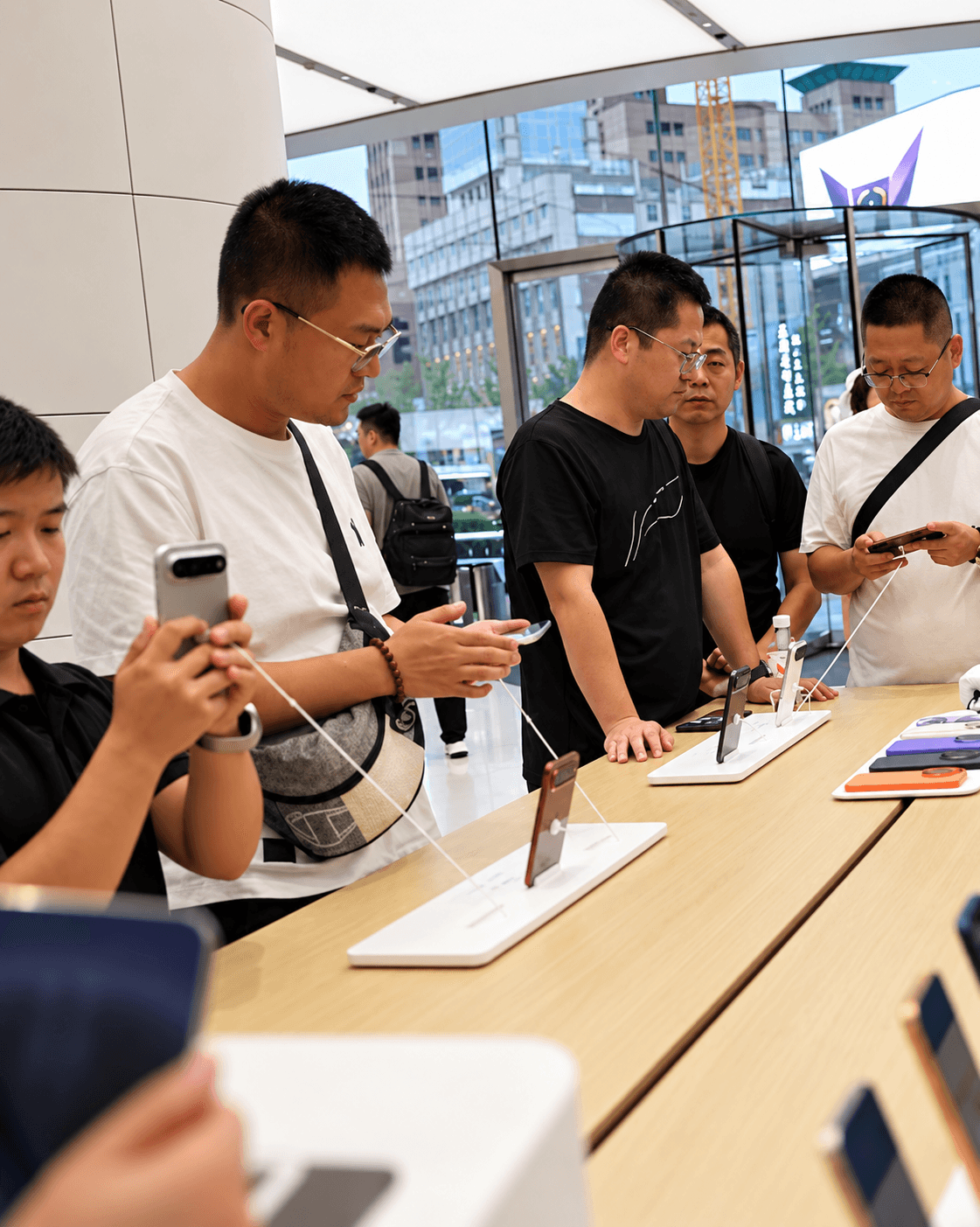
Huawei is doubling down on its push for technological independence. The Chinese technology giant has unveiled its Mate 90 smartphone series, putting its own processors, operating system and chip-design innovations at the heart of its effort to compete in the premium smartphone market.
The launch, announced on 1 October, is about more than a new range of phones. Huawei wants to show that it can continue developing competitive flagship devices despite restrictions on its access to some of the world’s most advanced semiconductor technologies.
At the centre of the strategy are Huawei’s Kirin processors, HarmonyOS 7 and a chip-design technique called LogicFolding, used in selected premium models. The company says the approach can improve processing efficiency by changing how connections are arranged inside a chip, potentially helping it get more out of the manufacturing technology available to it.
It is an ambitious approach, but the challenges are significant. Huawei must compete with smartphone makers that have access to advanced semiconductor supply chains while dealing with production bottlenecks and rising component costs.
The Mate 90 series will test whether Huawei’s engineering investments can translate into better products and whether its software ecosystem can convince customers to remain loyal to the brand or return to it.
Huawei’s progress is notable, but it does not mean China has overcome the obstacles facing its advanced semiconductor industry.
THE MATE 90 LINEUP: HUAWEI RAISES ITS PREMIUM GAME
The new lineup includes the Mate 90, Mate 90 Pro, Mate 90 Pro Max and higher-end special editions. Across the range, Huawei is introducing updated Kirin processors alongside improvements to cameras, displays, connectivity and on-device AI features.
By offering several models at different price points, the company is targeting a broad range of premium buyers, from customers seeking a flagship experience to those willing to pay more for top-end specifications.
Reported launch pricing in China
Model
Starting price reported
Huawei Mate 90
CNY 5,999
Huawei Mate 90 Pro
CNY 6,999
Huawei Mate 90 Pro Max
Higher premium tier
Mate 90 RS Ultimate Design
Up to CNY 12,999
The standard Mate 90 was reported to cost approximately US$895 at launch, while the top-end RS Ultimate Design reached CNY 12,999, or around US$1,939. Prices vary depending on the model and configuration.
These prices put Huawei firmly in the premium segment of China's smartphone market. That gives the company an opportunity to generate more revenue per device, but it also raises customer expectations.
Buyers paying flagship prices want more than an impressive processor. They expect reliable software, strong cameras, smooth performance, good battery life and dependable long-term support.
Huawei will need to deliver across all these areas if it wants the Mate 90 to stand out.
LOGICFOLDING: HUAWEI'S ANSWER TO CHIP RESTRICTIONS
One of the most closely watched developments in the Mate 90 launch is Huawei’s continued investment in its own chip architecture.
Selected premium Mate 90 models use the Kirin 9050 Pro, which incorporates Huawei’s LogicFolding approach. The technique is designed to reorganise internal chip connections in three dimensions rather than relying entirely on conventional planar layouts.
The idea is straightforward: improve the way data moves through the processor, make connections more efficient and potentially increase performance without relying solely on more advanced manufacturing processes.
For Huawei, this could be particularly valuable. US restrictions have made access to some advanced chipmaking technologies more difficult, forcing the company to look for other ways to improve its hardware.
Processor performance, after all, depends on more than transistor density or the manufacturing process. Architecture, memory access, power management and software optimisation also influence how a chip performs in everyday use.
However, there is a catch. A clever design cannot remove every limitation imposed by manufacturing technology.
Reuters reporting has also highlighted a potential cost to the LogicFolding approach: it reportedly requires more wafers to produce. That could put additional pressure on Huawei’s manufacturing capacity and increase the cost of producing each chip.
Huawei therefore faces a difficult balancing act. It needs to improve performance while keeping production efficient enough to support a commercially successful smartphone business.
Different models, different processors
There is another important detail in the Mate 90 lineup: not every model uses the same processor or architecture.
The standard Mate 90 is reported to use the Kirin 9030, while the Mate 90 Pro uses the Kirin 9035. Higher-end models use the Kirin 9050 family, including the Kirin 9050 Pro in selected editions.
Technical reporting links LogicFolding to the premium Kirin 9050-series chips, rather than to every processor in the range.
That distinction matters. It would be misleading to suggest that all Mate 90 models benefit from the same chip-design approach.
The different configurations allow Huawei to separate its devices by price and performance. The broader goal, however, remains consistent: develop more of its own technology and reduce dependence on external suppliers wherever possible.
US RESTRICTIONS CONTINUE TO SHAPE HUAWEI'S FUTURE
Huawei’s push into homegrown chips is closely tied to US export restrictions that have limited its access to advanced semiconductors and certain manufacturing equipment.
Those restrictions have forced the company to rethink how it designs smartphones, develops software and secures the production capacity needed to support its products.
Before the restrictions disrupted access to key suppliers, Huawei was one of the world’s leading smartphone manufacturers. Its flagship devices competed directly with established international brands.
Losing access to certain technologies made that position harder to maintain. Huawei responded by investing in domestic chip development, building its own operating system and expanding an ecosystem designed to reduce its reliance on foreign platforms.
The Mate 90 is another step in that effort.
Huawei consumer business chief Richard Yu has acknowledged that advanced semiconductor production capacity in China remains limited. The company’s Ascend AI chips also compete for access to the same constrained manufacturing resources.
That creates a challenge extending well beyond smartphones. China needs advanced processors for AI computing, cloud infrastructure and other strategic industries, all of which place demands on limited semiconductor capacity.
Huawei must therefore do more than design a capable chip. It needs to secure enough production capacity to manufacture that chip at a cost and scale that make commercial sense.
HARMONYOS 7: BUILDING A SOFTWARE ECOSYSTEM OF ITS OWN
Hardware is only half the story. Huawei also wants greater control over the software running on its devices.
The Mate 90 series runs on HarmonyOS 7, the company’s homegrown operating system. Huawei says the platform supports more than 450,000 apps and services.
That ecosystem is critical because people do not choose smartphones based on processor specifications alone. They also need messaging, banking, navigation, entertainment and productivity apps to work reliably.
A successful operating system must offer those services while giving developers good reasons to build and maintain applications for the platform.
HarmonyOS is Huawei’s attempt to reduce its dependence on Google’s Android ecosystem and create a software environment it can control more directly.
But building a competitive alternative takes time. App availability, compatibility, developer support and user habits can all influence whether customers are willing to switch.
China gives Huawei a substantial domestic market in which to develop the ecosystem. Expanding internationally may prove more difficult, particularly in countries where consumers depend heavily on Google services and apps that may not be available in the same way on HarmonyOS.
Huawei has discussed expanding HarmonyOS beyond China in the coming years. However, future plans should not be mistaken for evidence of an established global rollout.
CAN BETTER CHIP DESIGN MAKE UP FOR MANUFACTURING LIMITS?
Huawei’s central argument is that smarter chip architecture, combined with closer integration between hardware and software, can deliver meaningful improvements despite manufacturing restrictions.
There is a reasonable technical basis for that approach. Better scheduling, more efficient data movement, improved power management and software optimisation can all help processors make better use of their available resources.
But there are limits to what design changes can achieve.
More advanced manufacturing processes generally allow chipmakers to increase transistor density and improve aspects of performance and energy efficiency. Architectural improvements can help narrow certain gaps, but they cannot automatically reproduce every advantage of a more advanced manufacturing process.
Reporting on the Kirin 9050 Pro has described mixed results across performance tests. Some benchmarks reportedly show improvements, while other comparisons place the chip behind leading international processors. Results depend on the workload, testing conditions and device configuration.
For consumers, the real questions are practical:
Does the phone run demanding apps smoothly?
Can it maintain performance without overheating?
How well does it manage battery life?
Can its camera system compete with other flagship phones?
Are the applications and services people rely on available?
A processor may perform well in one test and struggle in another. Huawei will need to demonstrate that its improvements translate into a consistently good experience across gaming, AI tasks, everyday applications and long-term use.
MANUFACTURING CAPACITY MAY BE THE BIGGER OBSTACLE
Even if Huawei makes progress with chip design, manufacturing remains a major hurdle.
Advanced semiconductor production depends on sophisticated lithography equipment, precise process control, specialised materials and a highly developed network of suppliers. Restrictions on certain tools make it harder for Chinese manufacturers to advance towards the most sophisticated production processes.
Reuters has reported that Huawei’s Kirin chips are widely believed to be manufactured by Semiconductor Manufacturing International Corp (SMIC), China’s largest logic-chip foundry. However, Huawei has not publicly confirmed the manufacturer of the Kirin 9050 Pro in the reporting cited here.
China continues to rely on deep ultraviolet (DUV) lithography for advanced chip production, while extreme ultraviolet (EUV) lithography remains an important technology that domestic manufacturers have yet to establish at a comparable commercial scale.
The distinction is crucial because designing a processor and producing it in large quantities are two very different challenges.
Huawei might develop an innovative chip architecture, but that achievement will have limited commercial impact if the company cannot manufacture enough processors at a competitive cost.
The pressure is compounded by demand from Huawei’s AI hardware business. Smartphone processors and AI chips are competing for access to limited advanced manufacturing capacity.
If chip supplies remain tight, even a successful Mate 90 launch may not lead to the sales growth Huawei hopes to achieve.
RISING COMPONENT COSTS ADD ANOTHER CHALLENGE
Huawei is also dealing with rising component costs, adding another layer of pressure to its smartphone business.
Richard Yu has said that higher memory prices have added an average of around US$200 to the cost of each handset, squeezing margins.
When component costs rise, manufacturers have a few choices. They can absorb the increase and accept lower profits, raise prices, adjust specifications or focus more heavily on expensive models.
Huawei’s premium positioning may help it recover some of those costs. But higher prices can also make buyers think twice, especially when competing devices offer established software ecosystems and access to mature global supply chains.
The company must convince consumers that the Mate 90 delivers enough value to justify its price.
That makes the launch a test of both technology and business strategy. Huawei needs competitive products, but it also needs to manufacture and sell them profitably.
WHAT THE MATE 90 MEANS FOR THE GLOBAL SMARTPHONE MARKET
Huawei’s latest launch has implications beyond its own smartphone business.
The industry relies on a complex international network of chip designers, foundries, equipment manufacturers, software developers and component suppliers. Restrictions affecting one company can reshape investment priorities and encourage efforts to develop alternative technologies.
Huawei’s experience shows how trade restrictions can push companies to invest more heavily in domestic capabilities. Such efforts may help local suppliers develop new technologies, although building a competitive semiconductor ecosystem takes considerable time, money and expertise.
For smartphone rivals, Huawei’s renewed premium push adds competition in China, one of the industry's most important markets.
For policymakers, the launch highlights why technological progress cannot be measured through export restrictions alone. Restrictions can limit access to advanced equipment, but they do not prevent every advance in chip architecture, software development or system integration.
At the same time, the Mate 90 does not prove that those restrictions have failed. Manufacturing capacity, production costs and access to cutting-edge equipment remain substantial obstacles.
Ultimately, Huawei’s success will depend on how effectively it turns engineering advances into reliable devices that can be produced in sufficient quantities and sold at sustainable prices.
FACT CHECK METER
FACT METER: 96% — REPORTED LAUNCH AND CHIP STRATEGY; PERFORMANCE CLAIMS NEED CONTEXT
Status: The supplied reporting identifies 1 October 2026 as the Mate 90 series launch date and describes Huawei’s Kirin processors, LogicFolding architecture, HarmonyOS 7 and continuing semiconductor constraints.
Key details reported:
Huawei introduced multiple Mate 90 models with different Kirin processors.
Selected premium models use the Kirin 9050 Pro and LogicFolding architecture.
The phones run on HarmonyOS 7.
Huawei has acknowledged constraints on advanced semiconductor production capacity.
The company is continuing to develop its smartphone business despite US restrictions affecting access to advanced semiconductor technology.
Important distinctions:
LogicFolding is associated with selected premium processors, not necessarily the entire Mate 90 range.
Huawei’s performance claims should be distinguished from independently measured benchmark results.
The manufacturer of the Kirin 9050 Pro has not been publicly confirmed by Huawei in the cited reporting.
The launch does not establish that China has overcome its advanced chipmaking constraints.
Plans for international expansion do not demonstrate that HarmonyOS has achieved widespread global adoption.
AWX VERDICT: The Mate 90 represents a meaningful test of Huawei’s strategy to combine domestic chip design, software independence and premium hardware. LogicFolding could help improve performance under difficult manufacturing conditions, but production capacity, cost and software support will determine how far the company can go.
WHAT TO WATCH NEXT
Independent chip benchmarks: Further testing of the Kirin 9050 Pro will help clarify its CPU, graphics and AI performance, along with power consumption and thermal management.
Manufacturing capacity: Watch for signs that Huawei and domestic suppliers can increase chip production without pushing costs sharply higher.
HarmonyOS adoption: App availability, developer participation and customer retention will show whether the operating system can sustain long-term growth.
International expansion: Confirmed launches outside China will provide a clearer picture of Huawei’s ambitions to rebuild its overseas smartphone business.
Pricing and profit margins: Rising memory and component costs could affect demand, profitability and Huawei’s ability to compete with rival flagships.
US–China technology policy: Any changes to export controls or access to semiconductor equipment could influence Huawei’s future product development.
THE AWX BOTTOM LINE
Huawei’s Mate 90 launch is another attempt to reclaim a stronger position in the premium smartphone market while relying more heavily on technology developed in-house.
Its combination of Kirin processors, selected LogicFolding-based chips and HarmonyOS 7 shows how the company is adapting to a difficult technology environment. Rather than relying on unrestricted access to advanced foreign semiconductor technology, Huawei is looking for ways to improve performance through its own chip designs and software.
The road ahead will not be easy. Better architecture cannot eliminate manufacturing constraints, and a successful flagship needs much more than a capable processor. Production capacity, component costs, software availability and customer confidence will all influence the outcome.
The Mate 90 is therefore more than a product launch. It is a test of Huawei’s ability to turn technological resilience into commercial success.
Huawei is fighting to regain its place among premium smartphone makers. Its next big challenge is to produce competitive chips at scale and build a software ecosystem that customers genuinely want to use.
ATTLAS WIRE | AWX WORLD NEWS
Real Stories. Lasting Impact.


Comments
No comments yet.