

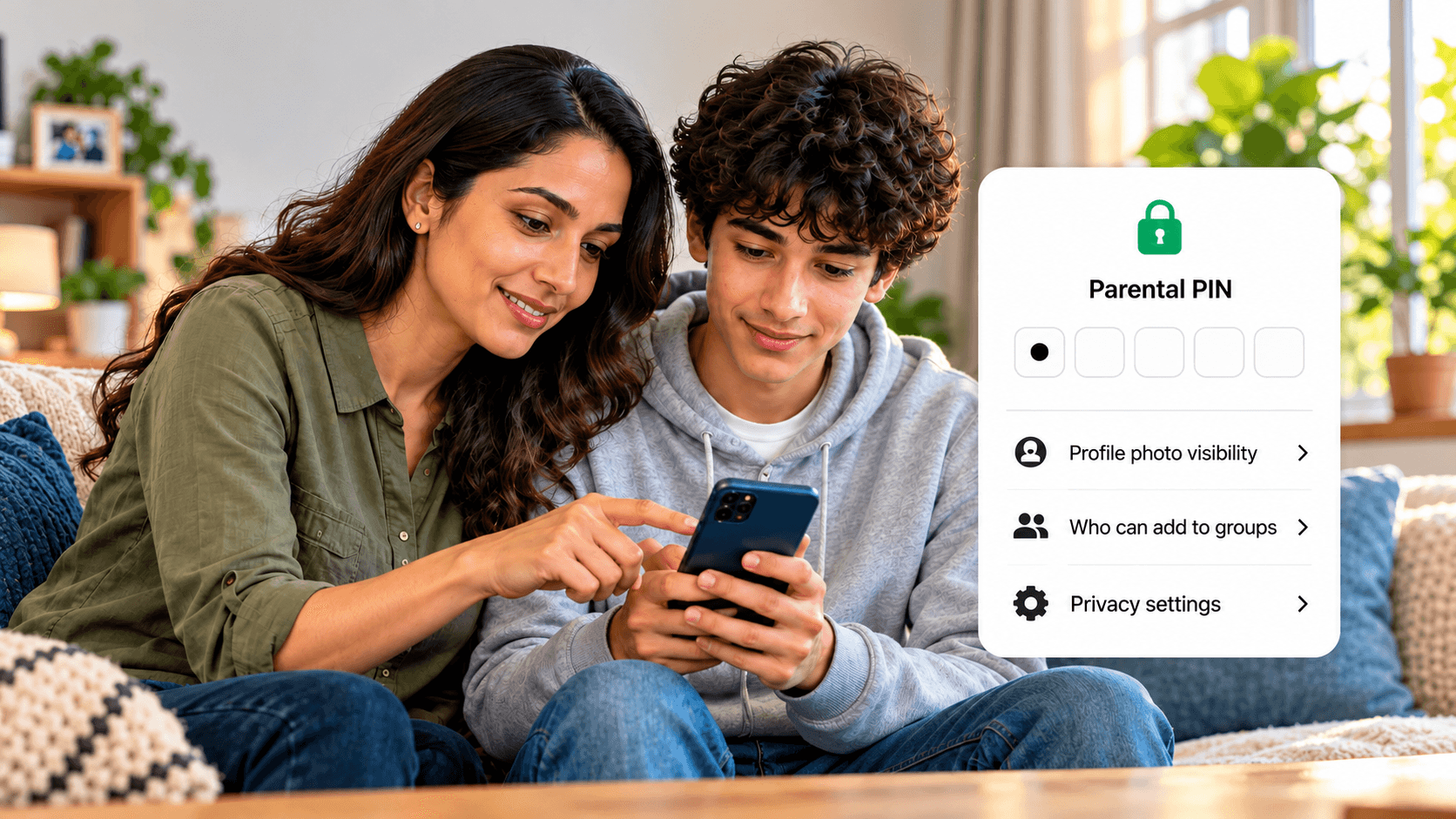
WhatsApp is giving parents more ways to help teenagers stay safe online. The messaging platform has introduced optional parental controls that let families manage selected privacy settings, keep track of certain account activities and place limits on some of the features teenagers can use.
Announced on 30 September, the new controls are designed to give parents a better understanding of their teenagers' online activity without allowing them to read private conversations. The settings cover group chats, profile visibility, Status updates, Channels and access to Meta AI.
Parents can protect key settings with a six-digit PIN and receive notifications about selected account changes. Some restrictions also require parental approval before they can be relaxed. The idea is to help families address potential online risks while preserving the privacy of personal messages and calls.
The announcement comes as parents, schools and governments look for better ways to protect young people from cyberbullying, unwanted contact, harmful content and other online risks.
WhatsApp plays a major role in everyday communication, from school groups and family chats to conversations between friends. While these groups help teenagers stay connected, they can also introduce them to unfamiliar people or expose them to content they may find difficult to handle.
The new controls give parents more say in how their teenagers use the platform. However, they do not provide complete access to a teenager's conversations, and the features are not automatically activated for every account.
The bigger question is whether parents can use these tools to improve online safety without undermining the privacy and independence teenagers need as they grow older.
WHAT'S NEW FOR TEENAGERS?
WhatsApp's new parental controls are designed for teenagers aged 13 to 17. Parents or guardians can link their accounts to a teenager's account and manage selected settings.
The feature is optional and is being rolled out gradually, so it may not be available to everyone yet. Setting it up requires participation from both the parent and the teenager.
The available controls cover several areas:
Group chats: Manage who can add the teenager to groups and receive notifications about selected group activity.
Profile privacy: Control who can see details such as the teenager's profile photo.
Status updates: Manage whose Status updates the teenager can view and who can see their own updates.
Channels: Restrict which public Channels the teenager can follow and whether they can create Channels.
Meta AI: Choose between the standard experience for users aged 13 and older and a more restricted Limited Content option.
Account activity: Receive selected alerts about changes, such as a new contact being added or a group growing significantly.
A six-digit Parent PIN protects key settings. Where parental approval is required, teenagers cannot simply change certain restrictions on their own.
Rather than blocking the entire platform, WhatsApp's approach allows parents to focus on the features they are most concerned about. For some families, that might mean limiting access to public Channels. For others, it could mean paying closer attention to group membership or profile privacy.
GROUP CHATS COME UNDER CLOSER WATCH
Group chats are a major part of the update.
Teenagers use WhatsApp groups to organise schoolwork, coordinate sports activities, plan outings and stay in touch with friends. But a group that starts with familiar people can quickly expand to include contacts a teenager barely knows.
The new controls allow parents to manage who can add their teenager to groups. They can also receive notifications about certain changes, including when the teenager joins or leaves a group or when a group grows substantially.
These alerts provide some visibility into changes in a teenager's online environment, but they do not reveal the full content of conversations or give parents access to group calls.
That distinction is important. A group growing quickly does not automatically mean something is wrong. However, it may give parents a reason to ask questions and find out whether their teenager feels comfortable with the people involved.
The aim is to make it easier for families to spot changes and discuss potential concerns before they become bigger problems.
Why group membership matters
Teenagers often join groups through classmates, friends and shared activities. Over time, those groups can include people they have never met in person.
Parents may not know when a group changes significantly unless their teenager tells them. Notifications can help bring those changes to their attention and open the door to conversations about privacy, unfamiliar contacts and responsible online behaviour.
Still, alerts alone cannot keep teenagers safe. Young users also need to know how to block unwanted contacts, report inappropriate behaviour and turn to a trusted adult when something makes them uncomfortable.
PRIVATE MESSAGES AND CALLS REMAIN OFF-LIMITS
WhatsApp has drawn a clear line between parental supervision and access to private conversations.
The new controls do not let parents read their teenagers' personal messages or listen to their calls. WhatsApp says personal messages and calls remain protected by end-to-end encryption, which prevents third parties from accessing their content in transit.
Parents can manage selected settings and receive certain account notifications, but they do not get a dashboard showing every message their teenager sends or receives.
This is an important part of WhatsApp's approach. Parents want to know when something might be wrong, while teenagers need some privacy as they become more independent.
The arrangement attempts to balance those needs without turning parental controls into a system for monitoring every conversation.
It also has limits. A teenager could still receive a harmful message from an existing contact or experience harassment without triggering any notification. The controls cannot guarantee that every problem will be identified.
That makes open communication just as important as the technology itself. Parents should encourage teenagers to talk about suspicious messages, scams, bullying and unwanted contact, while making sure they know how to report problems and ask for help.
META AI GETS AN EXTRA LAYER OF SUPERVISION
The update also covers Meta AI, the artificial intelligence assistant built into WhatsApp.
Parents can choose between the standard experience for users aged 13 and older and a stricter Limited Content option, which places additional restrictions on the topics teenagers can discuss. Some AI features, including private interactions that use Meta's Private Processing, are unavailable under the limited setting.
The move reflects growing concern about how teenagers interact with AI tools.
Young people may use AI assistants to answer questions, explore new ideas, get help with schoolwork or discuss personal concerns. These tools can be useful, but their responses are not always accurate or appropriate for every situation.
The Limited Content option gives parents another way to shape their teenager's experience. However, it should not be treated as a guarantee that every unsuitable response will be blocked.
No automated content filter can anticipate every possible question or situation. Parents should also help teenagers understand that AI-generated answers can be wrong and that serious questions about health, safety or personal problems may require guidance from a trusted adult or qualified professional.
STATUS AND CHANNELS: MORE CONTROL OVER WHAT TEENS SEE
WhatsApp is more than a private messaging service. Its Status and Channels features allow users to share updates and follow content from a wider audience.
Status lets people post temporary updates for selected viewers, while Channels allow users to follow public updates from organisations, creators and other publishers.
The new parental controls let parents decide whose Status updates their teenager can view and who can see the teenager's own posts. They can also choose whether their teenager can follow all Channels, only approved Channels or none at all. Parents can additionally restrict the creation of new Channels.
These options can help families limit exposure to unfamiliar accounts and public content they consider unsuitable.
They also create an opportunity to discuss online privacy. Teenagers may see a Status update as a casual post, but its audience depends on the privacy settings they choose.
Similarly, restricting Channels can help families keep WhatsApp focused on direct communication rather than unrestricted discovery of public content.
The intention is not to make every online decision for teenagers. Instead, parents can establish boundaries while helping young people understand why those limits matter.
THE PARENT PIN: WHO HAS CONTROL?
A six-digit Parent PIN protects key settings in the linked-account arrangement. It helps parents manage restrictions that teenagers cannot independently relax.
Without this protection, some controls could be easily changed, reducing their usefulness. The PIN gives parents a way to maintain the settings they have chosen.
It also comes with a responsibility. Parents should keep the PIN secure and understand which settings it protects.
WhatsApp's system is intended to remain flexible. Families can adjust restrictions as teenagers mature and their needs change, rather than relying on the same rules indefinitely.
That flexibility matters because a 13-year-old and a 17-year-old may need different levels of supervision. The right balance will depend on the teenager, the family's concerns and how responsibly the young person uses the platform.
HOW TO SET UP THE NEW CONTROLS
WhatsApp is rolling out the feature gradually, so some families may not see the option immediately.
Where the feature is available, the general setup process is as follows:
Open WhatsApp on the teenager's phone and go to Settings.
Select Parental controls and follow the instructions to confirm the teenager's age.
Begin linking the teenager's account to a parent or guardian.
Complete the account-linking and verification steps.
Create and confirm a six-digit Parent PIN.
Review the available settings for privacy, groups, Status, Channels and Meta AI.
Both the parent and teenager must participate in setting up the linked arrangement. The latest version of WhatsApp may also be required, and the exact steps can vary by device and account.
If the option is not available, families can update the app and check WhatsApp's Help Center for the latest rollout information.
It is also worth distinguishing these controls from WhatsApp's separate parent-managed accounts, which are designed for younger children and provide a more restricted messaging-and-calling experience. The teen parental controls discussed here are intended for users aged 13 to 17.
A RESPONSE TO GROWING CONCERNS ABOUT CHILD ONLINE SAFETY
WhatsApp's announcement comes as technology companies face increasing pressure to do more to protect children and teenagers online.
Governments in several countries are debating age restrictions, parental consent requirements and stronger rules for digital platforms. Concerns include cyberbullying, unwanted contact, harmful content and features that encourage people to spend more time online.
Messaging services face a difficult balancing act. Their usefulness depends on making communication easy, but leaving every setting open can expose younger users to avoidable risks. At the same time, overly restrictive controls could interfere with ordinary social interactions.
WhatsApp is offering families optional tools that can be tailored to their circumstances instead of imposing the same level of supervision on every teenager.
That approach could appeal to parents who want more visibility without reading private conversations. However, it also means families must understand the settings and decide which restrictions are appropriate.
Parental controls alone cannot solve broader problems involving age verification, harmful content, harassment or the speed at which platforms respond to abuse reports.
Their effectiveness will depend on how easy they are to use, whether families understand their limitations and whether they lead to meaningful improvements in online safety.
WILL MORE PARENTAL CONTROL MAKE TEENAGERS SAFER?
The new features offer additional ways to manage privacy and monitor selected account activity, but they are not a complete solution.
A teenager might still encounter disturbing content through another service, receive an inappropriate message from a familiar contact or experience harassment that does not trigger an alert. Even when parents receive a notification, they may need more context before deciding whether there is a genuine concern.
There is also a risk that overly strict restrictions could discourage teenagers from discussing problems with their parents. If young people feel that every online interaction will lead to punishment or confrontation, they may be less willing to ask for help.
For younger teenagers, tighter controls may make sense. Older teenagers may benefit from gradually greater independence as they demonstrate sound judgement and learn to manage online risks.
WhatsApp's optional approach gives families room to make those decisions, but the company must still explain clearly what the controls can and cannot do.
Ultimately, success should mean helping parents notice potential problems earlier, encouraging teenagers to speak up when something goes wrong and protecting reasonable privacy in everyday communication.
FACT CHECK METER
FACT METER: 98% — CORE FEATURES REPORTED AS CONFIRMED; AVAILABILITY MAY VARY
Status: WhatsApp announced its teen parental controls on 30 September 2026. The company's official blog and Help Center describe the settings, account-linking process and privacy protections. Availability may differ during the gradual rollout.
Confirmed details:
The controls are optional and designed for teenagers aged 13–17.
Parents can manage selected privacy settings and restrictions involving Status, Channels and Meta AI.
Selected account activity can trigger parental notifications.
A six-digit Parent PIN protects key settings.
The controls do not give parents access to private messages or calls.
The rollout is gradual, so the feature may not yet be available to every user.
Important distinctions:
Parents do not receive unrestricted access to private conversations.
The controls are not automatically activated for every teenager.
An alert about a group or contact does not establish that the interaction is dangerous.
Teen parental controls are different from parent-managed accounts designed for younger children.
The availability and behaviour of individual settings may vary by account and region.
AWX VERDICT: WhatsApp's new parental controls give families more options for managing teenagers' privacy and online interactions. Their real value will depend on adoption, clear communication and how effectively families use them. The tools can strengthen supervision, but they do not replace encryption, user reporting, digital literacy or open conversations about online safety.
WHAT TO WATCH NEXT
Rollout across India and other markets: Watch for updates confirming wider availability across accounts and devices.
Family adoption: Future company updates may indicate whether parents and teenagers are choosing to activate the optional controls.
Meta AI safeguards: Further changes could clarify how restricted AI settings work and how they limit exposure to unsuitable content.
Regulatory response: Governments may consider whether parental controls are sufficient or whether additional legal requirements are needed.
Privacy and trust: Feedback from families will help show whether the system strikes the right balance between supervision and teenage independence.
Evidence of better safety outcomes: The key question is whether the tools help families identify risks earlier, improve reporting or reduce harmful interactions.
THE AWX BOTTOM LINE
WhatsApp is giving parents more influence over how teenagers use its platform, with new options covering group participation, privacy settings, Status updates, Channels and Meta AI.
The approach offers a middle ground between unrestricted access and constant monitoring. Parents can receive selected alerts and protect important settings with a PIN, while private messages and calls remain end-to-end encrypted.
But no set of controls can guarantee online safety. Teenagers still need to recognise suspicious behaviour, understand their privacy settings and feel comfortable asking for help when something goes wrong.
The real test will be whether families find the tools useful and whether WhatsApp continues to improve its protections as online risks change.
More parental control can help families manage online risks. The goal is to make teenagers safer without taking away the privacy they need.
ATTLAS WIRE | AWX WORLD NEWS
Real Stories. Lasting Impact.



Comments
No comments yet.