

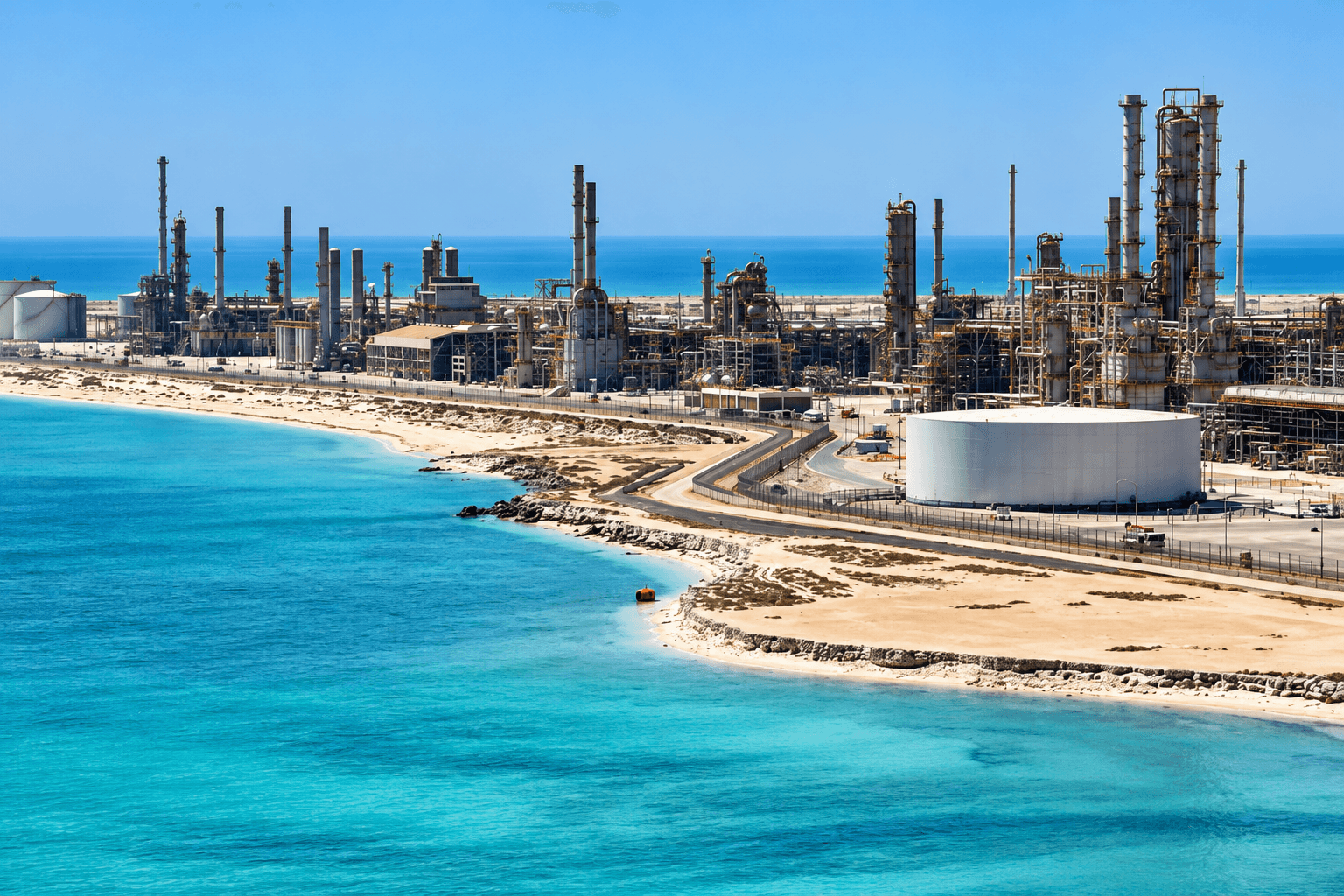
Saudi Arabia has resumed crude oil shipments through Yanbu, its major Red Sea export hub, following the restart of the East–West Pipeline. The recovery restores an important route for delivering oil to international markets at a time when security concerns continue to disrupt energy trade across the Middle East.
The pipeline was shut down in September following drone attacks, interrupting the flow of crude to Yanbu and bringing shipments to a halt. Operations restarted on 22 September, and tanker loadings resumed later in the month as Saudi Aramco worked to restore supplies from the kingdom’s eastern oil-producing region to its western export terminals.
The reopening has given Saudi Arabia more flexibility in moving crude to overseas buyers without depending entirely on the Strait of Hormuz, a critical passage for global energy shipments. With security concerns continuing to influence shipping decisions and push up transport costs, keeping alternative export routes operational has become increasingly important.
The recovery has gathered pace since the initial restart. Industry reports last week put East–West Pipeline flows at around 5.8 million barrels per day. Meanwhile, data reported by Reuters on 13 October showed that Saudi Arabia had increased production in September and continued adjusting its export arrangements to keep oil moving.
For Riyadh, the return of Yanbu shipments is an important step towards restoring normal operations. However, it does not mean the region’s wider oil trade is back to business as usual. Security threats, higher shipping costs and the possibility of further attacks continue to weigh on the outlook.
The immediate priority is straightforward: keep production connected to export markets, protect critical infrastructure and maintain reliable deliveries to international customers.
WHAT IS THE EAST–WEST PIPELINE?
Saudi Arabia’s East–West Pipeline, also known as Petroline, carries crude oil from the kingdom’s eastern production areas to export terminals on the Red Sea coast, including Yanbu.
The pipeline gives Saudi Arabia an alternative to shipping all its crude through the Persian Gulf and the Strait of Hormuz. Under normal circumstances, the strait is one of the world’s busiest energy corridors. When maritime security deteriorates, the pipeline allows the kingdom to redirect significant volumes of oil towards the Red Sea.
The system has a nominal capacity of approximately seven million barrels per day. Its actual throughput, however, depends on operating conditions, pumping infrastructure and the amount of crude required by domestic refineries.
That distinction is important. A pipeline capable of carrying seven million barrels a day will not necessarily operate at that level every day. Nor does every barrel transported west automatically become an export shipment.
Some crude is used by refineries along the route, while the remainder may be stored or prepared for export. Actual shipments also depend on terminal capacity, tanker availability and delivery schedules.
Even with these limitations, the East–West Pipeline remains one of Saudi Arabia’s most important safeguards against disruptions to oil shipping through the Gulf.
FROM SEPTEMBER SHUTDOWN TO RESUMED EXPORTS
The disruption began in September, when drone attacks forced Saudi Arabia to suspend operations on the East–West Pipeline. The shutdown interrupted crude supplies to Yanbu and temporarily removed a major alternative export route from the kingdom’s oil network.
Reuters reported on 22 September that pipeline operations had restarted, although initial pumping rates remained low. Saudi Aramco then worked to increase the flow of crude towards its western export facilities.
By 29 September, crude oil and refined-product loadings had resumed at Yanbu. Aramco had informed customers of its October loading schedule, while shipping data showed tankers returning to collect cargoes from the Red Sea terminal.
The initial recovery was gradual. Reports at the end of September put pipeline throughput at roughly two million to 2.65 million barrels per day, well below its nominal capacity. Industry sources expected flows to improve as operations stabilised, although restoring higher volumes would take time.
Later reporting pointed to a stronger recovery, with pipeline flows reaching around 5.8 million barrels per day. This suggests that Saudi Arabia has made considerable progress in bringing the alternative route back into operation.
The figures need to be viewed in context. The lower estimates reflected the early stages of the restart, while the higher figure represents a later stage of recovery. Neither should be confused with confirmed daily exports from Yanbu alone.
The overall picture is encouraging, but questions remain over how consistently the pipeline and associated export infrastructure can operate while regional security risks persist.
WHY YANBU MATTERS TO GLOBAL OIL MARKETS
Yanbu gives Saudi Arabia direct access to international shipping routes through the Red Sea. This allows the kingdom to move crude towards overseas customers without requiring every cargo to pass through the Strait of Hormuz.
That flexibility has become particularly valuable amid the conflict involving Iran, as security concerns have complicated shipping and raised questions about the reliability of energy deliveries from the Gulf.
The benefits extend beyond Saudi Arabia. Oil-importing countries need dependable supplies, while refiners must manage crude availability, transport costs, delivery schedules and the quality of oil their facilities can process.
For Saudi Arabia, restoring Yanbu shipments helps preserve access to customers in Asia and other international markets. It also reduces the pressure on a single maritime chokepoint to handle the kingdom’s export requirements.
Still, the Red Sea route is not risk-free. Tankers operating in the region face their own security concerns, and many voyages require additional travel before cargoes reach their final destinations.
The return of Yanbu shipments therefore gives the oil market more options. It does not eliminate the risks affecting regional energy trade.
SAUDI OIL PRODUCTION RISES AS EXPORTS ADJUST
Saudi Arabia sharply increased crude oil production in September as it adjusted to disruptions affecting its export network.
OPEC’s monthly report, published on 13 October, showed that Saudi crude production rose to approximately 8.372 million barrels per day in September, an increase of more than two million barrels per day from August, according to figures supplied by Saudi Arabia. OPEC+ production overall increased by around 900,000 barrels per day during the month.
The figures highlight the kingdom’s efforts to maintain supply during a period of logistical uncertainty. However, producing more oil and exporting more oil are two different things.
Crude can be held in storage, sent to domestic refineries or moved to export terminals while awaiting shipment. As a result, higher production does not automatically translate into an equivalent increase in deliveries to international buyers.
Data from Kpler cited by Reuters on 12 October put Saudi crude exports at approximately 6.67 million barrels per day in September, a seven-month high and broadly back around pre-war levels.
The figures suggest that exports were recovering even as Saudi Arabia continued to adjust how crude moved through its available routes.
Maintaining that progress will depend on stable production, reliable pipeline operations and uninterrupted access to export terminals. Any renewed disruption could force the kingdom to revise its shipping arrangements once again.
ASIAN REFINERS SECURE MORE SAUDI CRUDE
Asian refiners are continuing to secure Saudi crude as they look for ways to manage supply uncertainty and higher shipping costs.
Reuters reported on 12 October that refiners in China, India and Taiwan had purchased at least 12 million barrels of Saudi crude for November loading through spot tenders and private negotiations. Some cargoes were reportedly priced at premiums of around $20 per barrel above November official selling prices.
The purchases suggest that buyers are looking to secure supplies despite the risks and additional costs associated with shipping through the region.
Aramco has maintained allocations for cargoes loading at Yanbu and Egypt’s Sidi Kerir, giving customers alternatives to routes more directly exposed to disruption. Saudi Arabia has also used spot sales to reach buyers prepared to arrange different shipping and delivery terms.
For refiners, securing crude can come at a price. Freight rates, insurance premiums and the availability of suitable tankers all affect the final cost of a shipment.
The reported premiums should not be taken as a standard price for every Saudi cargo. Actual costs vary depending on the crude grade, contract terms, destination and timing of the transaction.
For India, China and other major importers, resumed Yanbu shipments provide another option when arranging supplies. Whether that translates into lower overall import costs will depend on how crude prices and shipping conditions develop.
RIYADH PLANS TO EXPAND ALTERNATIVE EXPORT CAPACITY
Saudi Arabia is already looking beyond the immediate recovery and considering ways to make its export network more resilient.
On 12 October, Energy Minister Prince Abdulaziz bin Salman said the kingdom was looking to increase pipeline export capacity to as much as 10 million barrels per day. The plan includes temporarily converting a domestic gas pipeline to carry crude oil, alongside upgrades to the East–West Pipeline and related infrastructure.
According to the minister, the temporary conversion could add around 1.2 million barrels per day of export capacity within seven to eight weeks. Further investment in pumping stations and other infrastructure could eventually add as much as three million barrels per day of capacity, with the broader expansion targeted over the next two to three years.
The plans reflect a clear lesson from the September shutdown: having an alternative route is only part of the solution. That route also needs sufficient capacity and the ability to operate reliably when a crisis disrupts normal shipping.
Expanding pipeline options could give Saudi Arabia more room to redirect crude away from vulnerable maritime corridors. It could also help the kingdom respond more quickly when existing export routes come under pressure.
However, the proposed figures represent future capacity, not oil already flowing through an expanded system. The timeline will depend on engineering work, investment, operating requirements and the availability of crude for export.
WHAT THE RESTART MEANS FOR INDIA
India is particularly exposed to changes in Saudi oil shipments because it relies heavily on imported crude to meet domestic energy demand.
The return of Yanbu loadings gives Saudi Arabia another way to supply Indian refiners without sending every cargo through the Strait of Hormuz. This can make delivery planning more flexible and reduce dependence on a single shipping corridor.
But an alternative route does not automatically mean cheaper oil.
Longer journeys, higher insurance costs, tanker availability and competition for cargoes can all keep delivered crude prices elevated. The final price paid by Indian refiners also depends on crude grades, contractual arrangements, exchange rates and wider market conditions.
Recent spot purchases by Indian and other Asian refiners indicate that buyers remain willing to secure Saudi crude despite the additional costs associated with the current market.
For Indian consumers, the impact will be indirect. Petrol and diesel prices depend on several factors, including international crude prices, refining costs, currency movements, taxes and decisions by fuel retailers.
The resumption of Yanbu shipments is therefore a positive development for supply security, but it should not be mistaken for a guarantee of immediate relief at the pump.
THE RISKS THAT REMAIN
Saudi Arabia has made progress in restoring its alternative export route, but several challenges could still affect the recovery.
Pipeline security: The September attacks showed how quickly critical energy infrastructure can be disrupted. Protecting pumping stations and related facilities will remain essential.
Shipping risks: Tankers using Red Sea routes continue to face regional security concerns, while vessels travelling through the Gulf face their own challenges.
Transport costs: Higher insurance premiums, freight rates and longer voyages can reduce the financial benefits of rerouting crude.
Operational capacity: Export volumes depend on pipeline throughput, refinery demand, storage and terminal operations—not just the system’s stated capacity.
Market uncertainty: Further escalation could affect oil prices, shipping schedules and buyers’ willingness to commit to cargoes.
The challenge for Saudi Arabia is to turn the restart into a sustained recovery. The route is operating again, but its long-term value will depend on whether it can continue moving large volumes of crude under difficult conditions.
FACT CHECK METER
FACT METER: 98%
STATUS: EXPORTS RESUMED — PIPELINE RECOVERY UNDERWAY
CONFIRMED: Saudi Arabia restarted the East–West Pipeline on 22 September 2026 following a shutdown linked to drone attacks.
CONFIRMED: Crude oil and refined-product loadings had resumed at Yanbu by 29 September, and Aramco had informed customers of its October loading schedule.
REPORTED: Industry reporting subsequently put pipeline flows at approximately 5.8 million barrels per day, indicating a substantial recovery from the initial restart.
CONFIRMED: Saudi crude production reached approximately 8.372 million barrels per day in September. Separately, Kpler data cited by Reuters put crude exports at around 6.67 million barrels per day.
IMPORTANT DISTINCTION: Pipeline capacity, actual throughput and exports from Yanbu are different measures. A pipeline’s maximum capacity does not establish how much oil is flowing or how much is being shipped to international buyers.
IMPORTANT DISTINCTION: Saudi Arabia’s plan to expand pipeline export capacity towards 10 million barrels per day is a future target, not a description of current operating capacity.
AWX VERDICT: The resumption of Yanbu shipments marks a meaningful improvement in Saudi Arabia’s ability to move crude through an alternative route. The durability of that recovery will depend on pipeline reliability, shipping security and the availability of export capacity.
WHAT TO WATCH NEXT
1. Pipeline throughput: Updated figures will show whether East–West Pipeline flows remain close to recovered levels or increase further.
2. Yanbu tanker loadings: Vessel movements and loading schedules will help establish whether shipments are continuing consistently.
3. Saudi crude exports: Monthly data will show whether the kingdom can sustain shipments while balancing production, domestic refinery demand and storage.
4. Asian refinery purchases: New tenders and contract nominations will indicate whether buyers are increasing their reliance on Saudi crude delivered through alternative routes.
5. Pipeline expansion plans: Progress on the proposed gas-pipeline conversion and East–West infrastructure upgrades will provide a clearer picture of how quickly additional export capacity could become available.
6. Regional security and oil prices: Any new attacks or shipping restrictions could affect freight costs, delivery schedules and global crude prices, even if pipeline operations remain stable.
THE AWX BOTTOM LINE
Saudi Aramco’s return to exports through Yanbu is an important step in restoring the kingdom’s oil logistics after September’s pipeline disruption. The East–West Pipeline has reconnected Saudi Arabia’s eastern production region with its Red Sea export terminals, giving Riyadh greater flexibility at a time when regional shipping remains under pressure.
The recovery is reflected in resumed tanker loadings, stronger reported pipeline flows and renewed purchases by Asian refiners. Saudi Arabia is also exploring infrastructure changes that could increase the volume of crude it can move through alternative routes in the years ahead.
Still, getting the pipeline running again is only part of the challenge. Protecting energy infrastructure, managing maritime risks and controlling transport costs will all influence whether the recovery can be sustained.
For global oil markets, Yanbu’s return offers a welcome source of flexibility. The bigger test now is whether Saudi Arabia can maintain reliable shipments while uncertainty continues to shape the region’s energy trade.
ATTLAS WIRE | AWX WORLD NEWS
Real Stories. Lasting Impact.



Comments
No comments yet.