

Qatar’s stock market ended lower on Monday as renewed military tensions between the United States and Iran unsettled investors across the Gulf. The Qatar Stock Exchange benchmark fell 0.6%, with most sectors finishing in negative territory as concerns about regional security and possible shipping disruptions weighed on sentiment.
The decline was part of a broader selloff across Gulf markets. Dubai’s main index dropped 0.8%, Abu Dhabi’s benchmark slipped 0.4%, and Saudi Arabia’s market lost 0.3%. Investors were increasingly concerned about military activity near the Strait of Hormuz, a vital route for global oil and gas shipments.
In Qatar, Qatar Fuel Company was among the session’s biggest losers, with its shares falling 6.7%. Qatar National Bank (QNB), one of the region’s largest lenders, also moved lower, declining 0.6%.
The selling reflected growing fears that further deterioration in US–Iran relations could disrupt commercial shipping, push up insurance and transportation costs, and create fresh challenges for energy exporters across the Gulf.
Qatar has a particular interest in keeping regional shipping routes secure. As one of the world’s major liquefied natural gas (LNG) exporters, the country relies heavily on energy production and dependable access to international markets.
Monday’s decline does not necessarily mean that Qatar’s listed companies are facing weaker earnings or worsening business conditions. Instead, it highlights how quickly geopolitical developments can affect investor confidence in a region where energy exports and international trade play such an important role.
WHAT TRIGGERED THE MARKET DECLINE?
The immediate concern was a fresh round of military activity around the Strait of Hormuz.
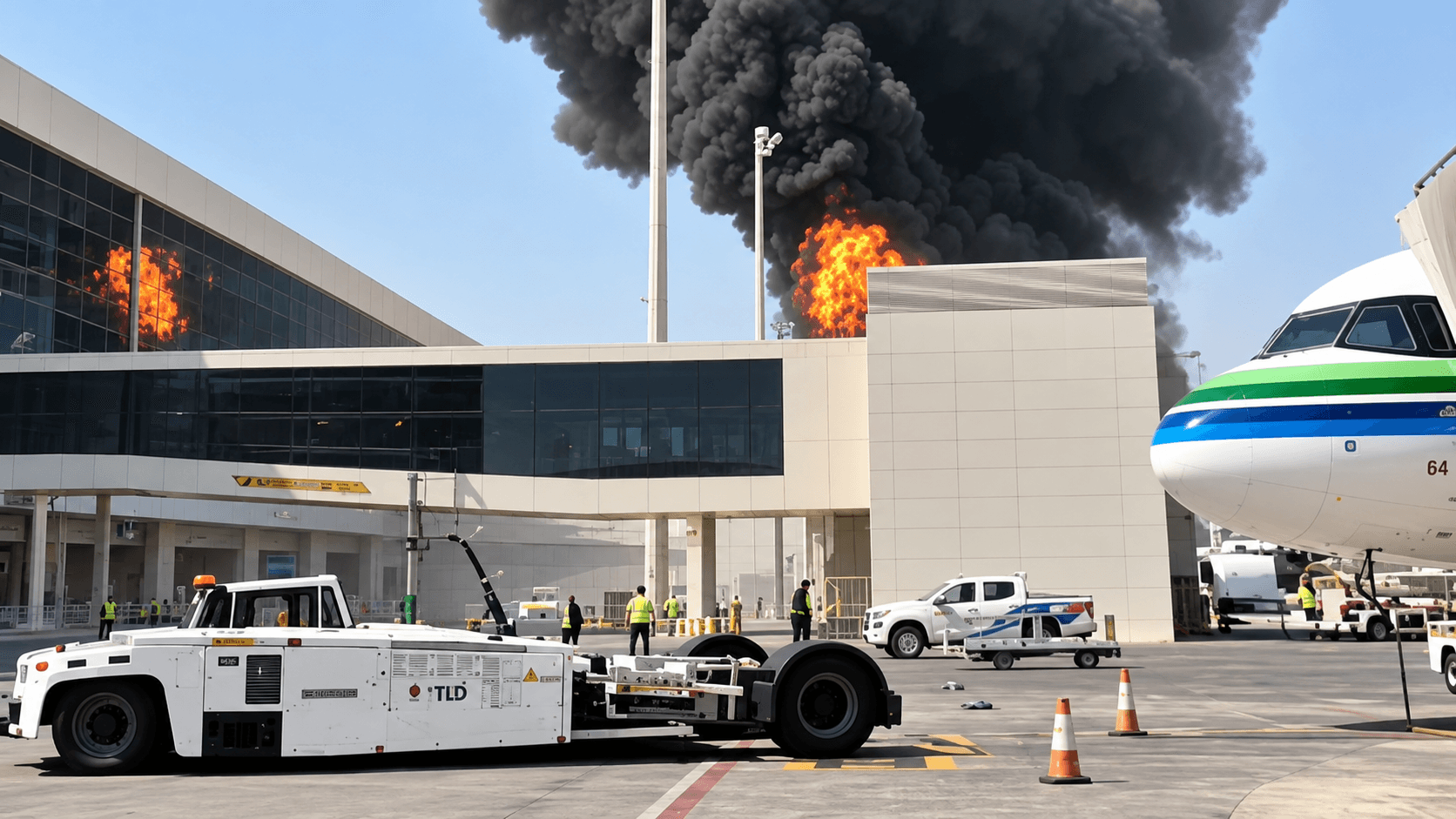
According to Reuters reporting on 31 August, US forces struck two Iranian launchers on Larak Island near the strategic waterway on Sunday. Iran later retaliated against US forces stationed in Jordan and said it had struck a tanker passing through the strait.
The United Arab Emirates also reported that its air force had intercepted a drone originating from Iran over its territorial waters. The developments raised concerns about further escalation and the safety of commercial vessels operating in the region.
For investors, the risks go beyond the immediate military exchanges. A prolonged confrontation could disrupt oil and gas deliveries, increase shipping insurance premiums and force operators to reconsider their routes.
Markets often react before the full economic impact of a crisis becomes clear. When uncertainty rises, investors may reduce their exposure to companies and markets they believe could be vulnerable to regional instability.
That helps explain why several Gulf stock exchanges fell during the same session, despite differences in their economies and sector compositions.
QATAR FUEL AND QNB COME UNDER PRESSURE
Losses in major listed companies added to the pressure on Qatar’s benchmark index.
Qatar Fuel Company shares fell 6.7%, making the stock one of the market’s biggest decliners. QNB shares slipped 0.6%, contributing to the broader decline.
Although both companies are important to Qatar’s economy, their businesses face different risks. Qatar Fuel is involved in fuel distribution and related activities, while QNB is a major financial institution with extensive regional banking operations.
Their share-price movements should not automatically be interpreted as signs of a common operational problem. Stock prices can respond to investor sentiment, changing valuations, market positioning and company-specific developments.
Banks may be affected by concerns about economic growth, credit demand and regional financial conditions. Energy-related businesses, meanwhile, can be influenced by commodity prices, operating expenses and disruptions to trade or transportation.
Monday’s trading showed how a geopolitical shock can put pressure on companies across different sectors, even when their underlying business risks are not the same.
WHY THE STRAIT OF HORMUZ MATTERS
The Strait of Hormuz connects the Persian Gulf with international maritime routes and is one of the world's most important corridors for energy shipments. It carries substantial volumes of crude oil, petroleum products and LNG from Gulf producers to overseas markets.
Any prolonged disruption could have consequences well beyond the Middle East. Higher freight rates and insurance premiums can make energy deliveries more expensive, while delays can complicate supply planning for refiners, power companies and industrial customers.
For Qatar, reliable maritime access is particularly important because LNG exports are central to its international trade and energy relationships.
Even if production facilities continue operating normally, exports could face difficulties if tankers encounter restrictions, shipping companies avoid certain routes or insurance costs rise sharply.
The market reaction on 31 August reflected concern about these potential risks. It does not, on its own, establish that Qatar’s energy shipments had stopped or that the Strait of Hormuz was completely closed.
That distinction is important. Security incidents can increase the risk premium investors attach to regional assets, but the actual economic damage depends on how long disruptions last and how governments and businesses respond.
QATAR’S ECONOMIC OUTLOOK FACES ADDED UNCERTAINTY
The stock market decline came against a challenging economic backdrop.
Official data cited by Reuters showed that Qatar’s economy contracted by 7% year on year in the first quarter of 2026. Lower energy production, linked to the wider Middle East conflict, weighed on economic activity.
The figures underline how closely Qatar’s economic performance is connected to energy production and export infrastructure.
Lower output can affect export revenues and related business activity. Uncertainty surrounding shipping routes can also influence investment decisions and business confidence, with potential knock-on effects for contractors, logistics providers and companies supplying the energy industry.
However, the 7% contraction refers specifically to economic activity during the first quarter. It does not mean every sector of the economy shrank by the same amount, nor does it establish that the same pace of contraction continued throughout the year.
Qatar’s outlook will depend on several factors, including energy production, export conditions, domestic demand and the wider regional security situation.
For investors, the combination of geopolitical tensions and economic uncertainty makes it harder to assess future earnings and determine what companies are worth.
GULF STOCK MARKETS FALL IN TANDEM
Qatar was not the only market to finish lower on 31 August.
Dubai’s main index declined 0.8%, Abu Dhabi’s benchmark lost 0.4%, and Saudi Arabia’s market slipped 0.3%. Real estate and information technology stocks were among the weaker performers in Saudi Arabia.
The simultaneous declines pointed to a broader pullback in investor risk appetite across Gulf equities.
The region’s markets are linked through energy revenues, trade, investment flows and investor positioning. When security concerns intensify, international investors may reassess their exposure to several Gulf markets at once.
However, the losses varied between exchanges, and individual stocks did not all move in the same direction. Differences in sector exposure, company performance and valuations continued to shape trading.
The selloff should therefore not be viewed as a uniform assessment of every Gulf economy. Rather, it suggests that investors were becoming more cautious in response to a shared regional security risk.
The next few trading sessions would help show whether the declines were a short-lived reaction or the start of a more prolonged period of weakness.
WHAT THE DECLINE MEANS FOR INVESTORS
For investors with exposure to Qatari equities, the central question is how the regional security situation could affect company earnings, valuations and confidence.
Geopolitical uncertainty often brings greater market volatility. Investors may become more reluctant to take risks, delay new investments or sell holdings while waiting for clearer signals.
The effects, however, will differ from one business to another.
Energy producers and related companies may benefit from higher benchmark prices in some circumstances. But those gains could be offset by lower production, damage to infrastructure, or rising transportation and operating costs.
Banks may face changing expectations for economic growth and borrowing demand, although the impact will depend on each institution’s financial strength, loan portfolio and regional exposure.
For long-term investors, one day of losses is not enough to determine whether a stock has become undervalued or whether its underlying business has weakened. A more complete assessment requires looking at earnings, balance sheets, valuations and the likely duration of any disruption.
For now, the focus remains on whether regional tensions ease and whether investor confidence begins to recover.
ENERGY SECURITY REMAINS A KEY CONCERN
The developments around the Strait of Hormuz have once again highlighted the importance of secure shipping routes and reliable energy infrastructure across the Gulf.
For Qatar, maintaining dependable LNG exports is essential to its position in global energy markets. For neighbouring economies, secure maritime access supports crude oil shipments, international trade and industrial activity.
The risks extend beyond direct attacks or a complete shutdown of a shipping route. Repeated security incidents can push up insurance premiums, alter vessel routes and create uncertainty over delivery schedules even when trade continues.
Those additional costs can eventually affect businesses, supply chains and expectations for corporate earnings.
At the same time, market movements depend on more than geopolitical developments alone. Energy prices, interest rates, company results and domestic economic conditions all influence how investors value regional assets.
The key question is whether the latest escalation remains limited or develops into a more sustained disruption to the movement of energy and goods.
FACT CHECK METER
FACT METER: 98%
STATUS: MARKET DECLINE REPORTED — REGIONAL SECURITY CONCERNS WEIGH ON GULF EQUITIES
CONFIRMED: Qatar’s benchmark index fell 0.6% on 31 August 2026, with most sectors ending the session lower.
CONFIRMED: Qatar Fuel Company shares dropped 6.7%, while QNB declined 0.6%.
CONFIRMED: Dubai’s index fell 0.8%, Abu Dhabi’s benchmark lost 0.4%, and Saudi Arabia’s index declined 0.3%.
CONFIRMED: Reuters reported an escalation in military activity near the Strait of Hormuz, including US strikes on Iranian launchers, Iranian retaliation and a reported strike on a tanker.
IMPORTANT DISTINCTION: The 0.6% decline refers to Qatar’s market on 31 August 2026. It should not be presented as the latest market result for 14 October 2026.
IMPORTANT DISTINCTION: Qatar’s reported 7% economic contraction relates to the first quarter of 2026. It is a separate economic measure, not a stock market loss, and does not mean every sector contracted by the same amount.
AWX VERDICT: Qatar’s market fell amid heightened regional security concerns and a broader decline across Gulf equities. The longer-term effects on corporate earnings and the economy will depend on developments in the conflict, energy production and shipping conditions.
WHAT TO WATCH NEXT
1. US–Iran relations: Further military action or setbacks in diplomatic efforts could keep investors on edge. Any meaningful de-escalation may help restore confidence.
2. Strait of Hormuz shipping: Vessel movements, security incidents, freight rates and insurance premiums will offer clues about whether commercial shipping conditions are stabilising.
3. Qatar’s energy production: Changes in output and export volumes will be important indicators of the country’s economic outlook and the performance of energy-linked businesses.
4. Qatar Fuel and QNB shares: Their performance in subsequent sessions may help show whether the selling remains concentrated in individual stocks or spreads across the wider market.
5. Qatar’s economic data: Upcoming growth figures will help establish whether the first-quarter contraction was followed by a recovery or further weakness.
6. Other Gulf exchanges: Movements in Dubai, Abu Dhabi and Saudi Arabia will help investors assess whether regional market pressure is easing or continuing.
THE AWX BOTTOM LINE
Qatar’s stock market fell 0.6% on 31 August as renewed US–Iran military tensions raised concerns about the security of the Strait of Hormuz.
Sharp losses in Qatar Fuel and a smaller decline in QNB added to the pressure on the benchmark. Similar falls in Dubai, Abu Dhabi and Saudi Arabia showed that investors were reassessing risks across the Gulf rather than reacting to developments in Qatar alone.
The selloff does not prove that Qatar’s listed companies have suffered a comparable deterioration in their underlying businesses. It does, however, show how quickly regional security concerns can influence financial markets when energy exports and international shipping are at stake.
Much will depend on whether tensions ease, energy shipments remain reliable and investors regain confidence in the regional outlook. Until there is greater clarity, volatility is likely to remain a concern for Qatar’s stock market.
ATTLAS WIRE | AWX WORLD NEWS
Real Stories. Lasting Impact.

Comments
No comments yet.